BACK TO finale_winnerS
HONORARY MENTION: INTERIOR DESIGN CATEGORY
THREADS OF HOPE: REVIVING NOKSHIKANTHA THROUGH COMMUNITY DESIGN INTERVENTION
THREADS OF HOPE: REVIVING NAKSHIKANTHA THROUGH COMMUNITY DESIGN INTERVENTION. In the villages of Jamalpur, Bangladesh, Nakshikatha is more than a craft; it is a living archive of memory, emotion and identity. Every stitch tells a story, a story passed down from generation to generation, stitched by the hands of women who turn scraps of cloth […]

THREADS OF HOPE: REVIVING NAKSHIKANTHA THROUGH COMMUNITY DESIGN INTERVENTION.
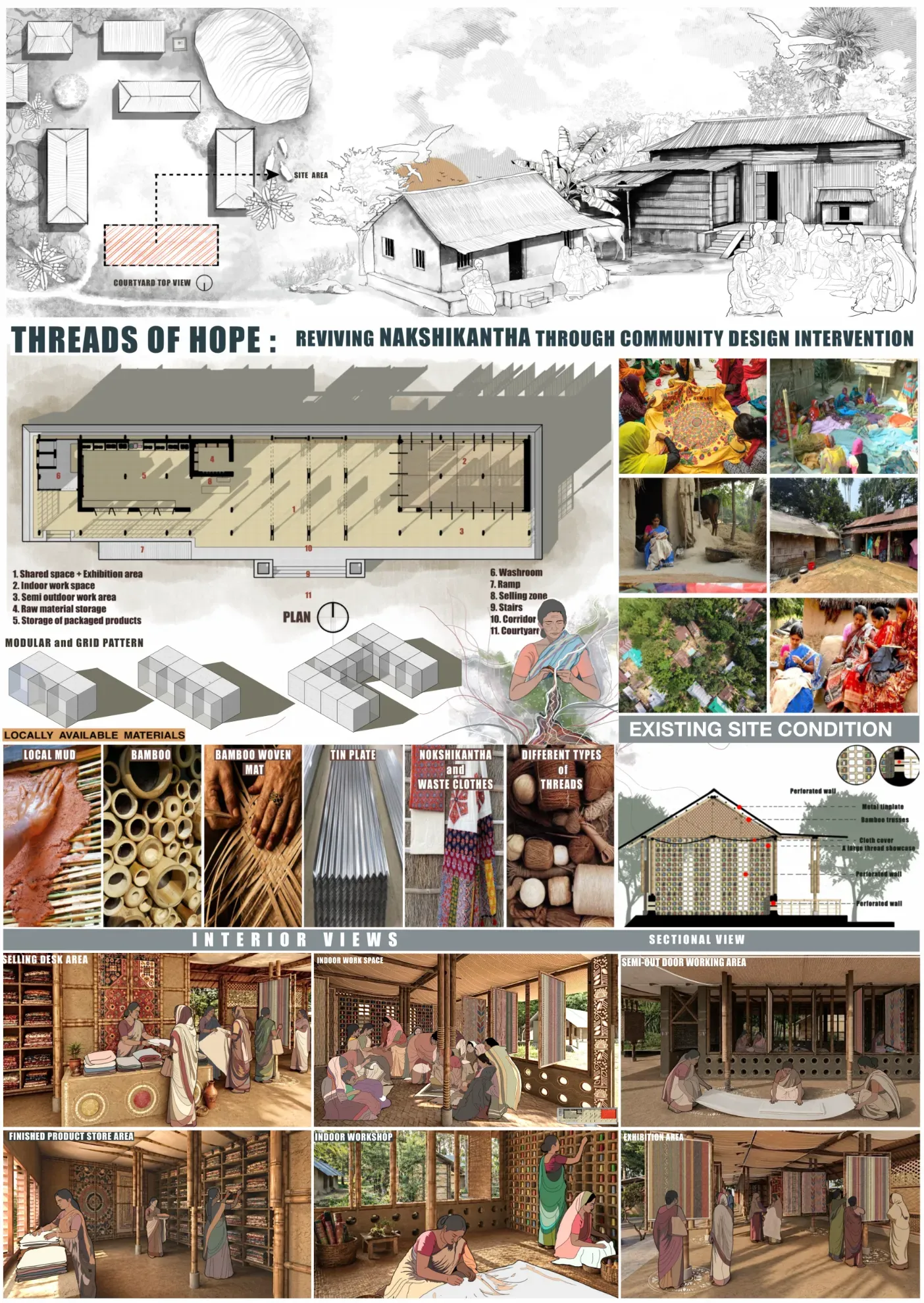
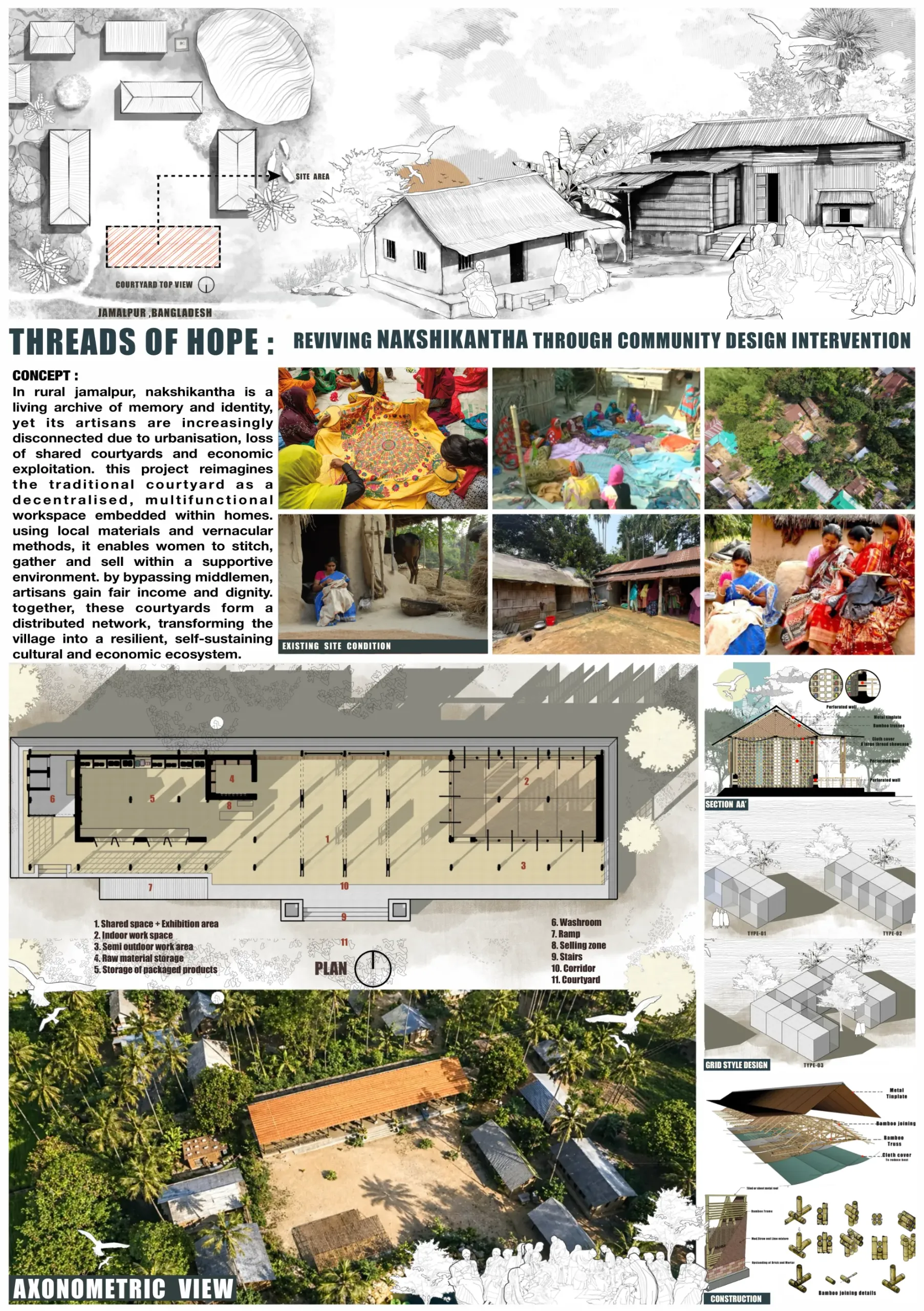
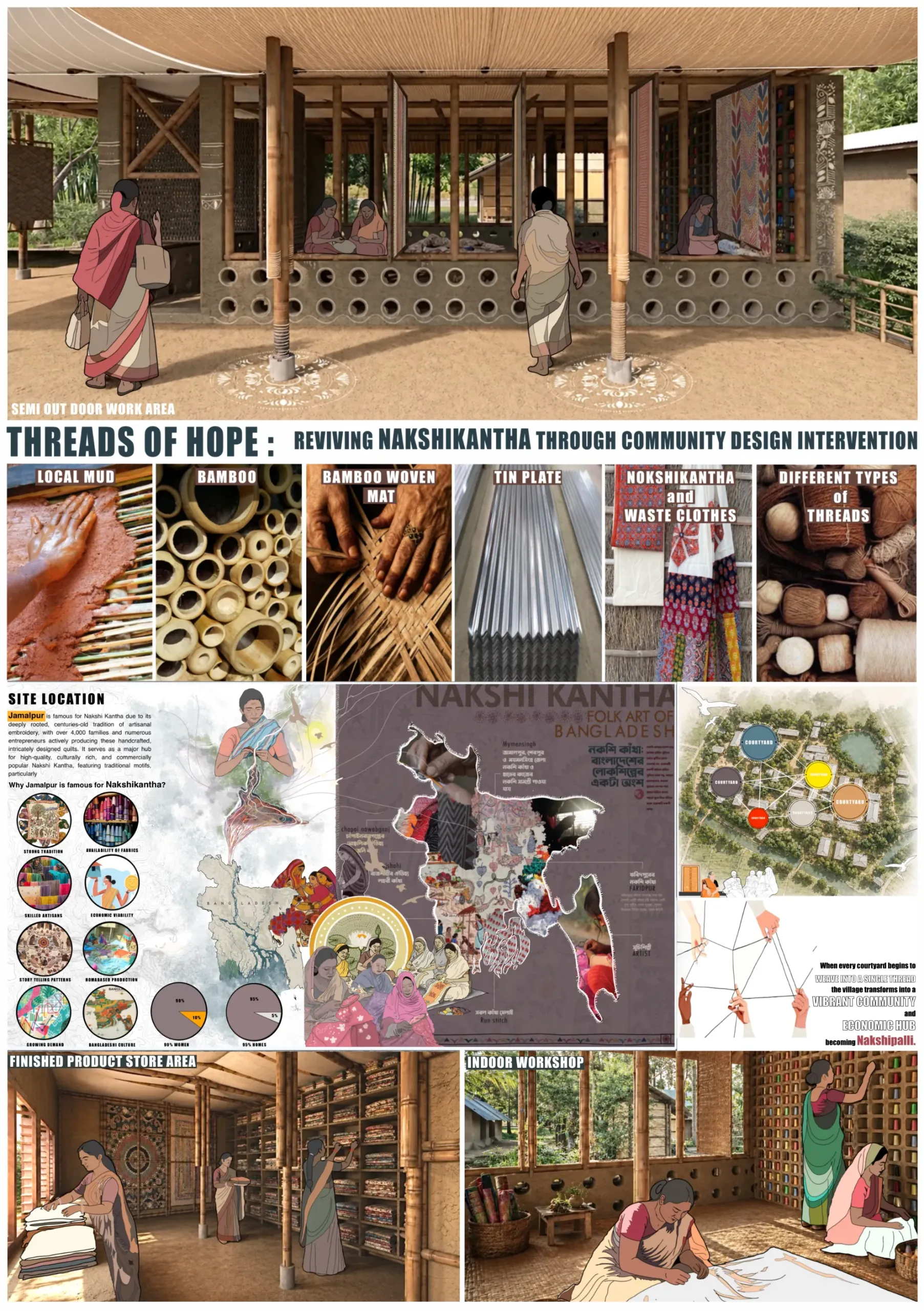
In the villages of Jamalpur, Bangladesh, Nakshikatha is more than a craft; it is a living archive of memory, emotion and identity. Every stitch tells a story, a story passed down from generation to generation, stitched by the hands of women who turn scraps of cloth into stories of life. Once a rural craft, deeply embedded in the everyday culture, Nakshikatha has now become a global symbol of Bangladesh across fashion and artisanal industries. But ironically, the communities that continue this tradition are slowly fading from it.
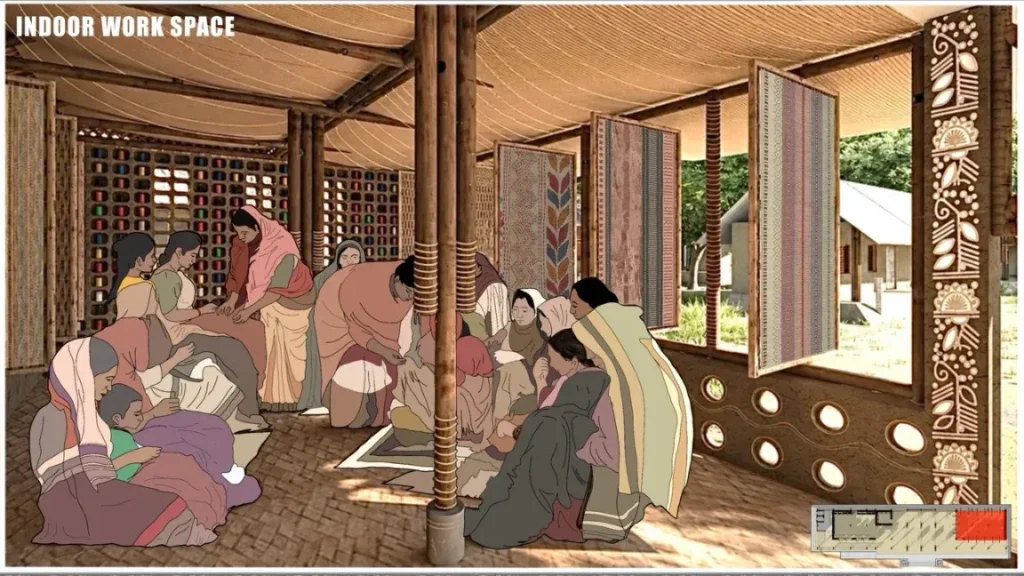
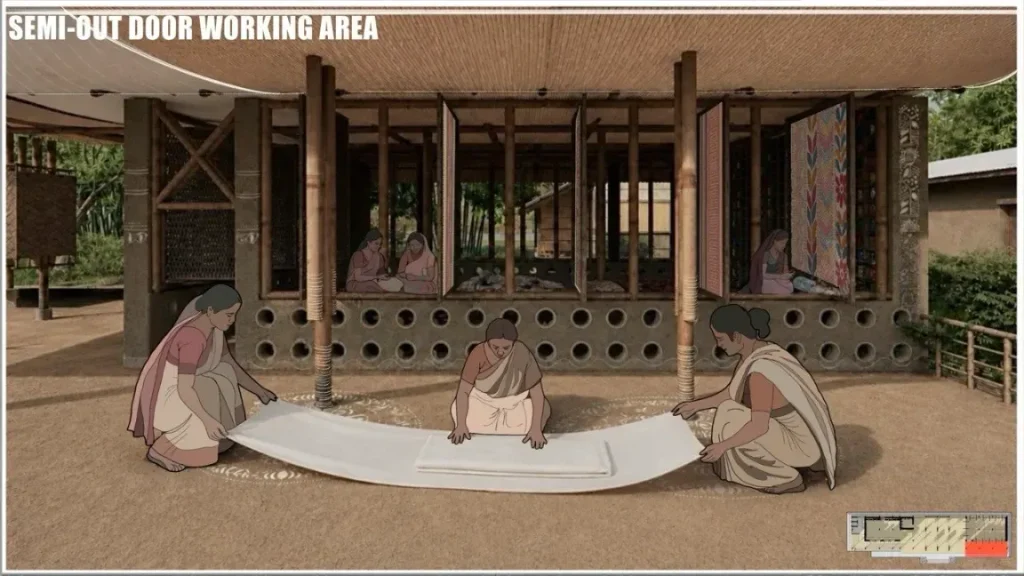
This laborious craft has been losing its grip on people gradually due to rapid urbanisation, growing preference for nuclear family structures and the growing inclination towards easily available industrial alternatives. More importantly, the artisans themselves, many of whom hail from economically precarious situations, are being cut off from the spatial and social contexts that have supported their work. Due to population density and the fragmentation of living conditions, traditional shared courtyards where women used to get together, sew, talk and produce together are disappearing. As a result, the communal character of Nakshikatha is disintegrating.Artisans are forced to work in lonely improvised settings, which are not responsive to the climate nor socially engaging, because of lack of enough workspaces. Heat, rain and storms are other seasonal challenges that interrupt their productivity.
Furthermore, exploitative market systems frequently deny them just wages, with intermediaries taking advantage of their craft and providing them with little pay. This economic imbalance, coupled with the failure to provide basic requirements like education and household stability, is forcing many artisans to give up their main profession. Some see it merely as a side hustle, some quit it altogether.
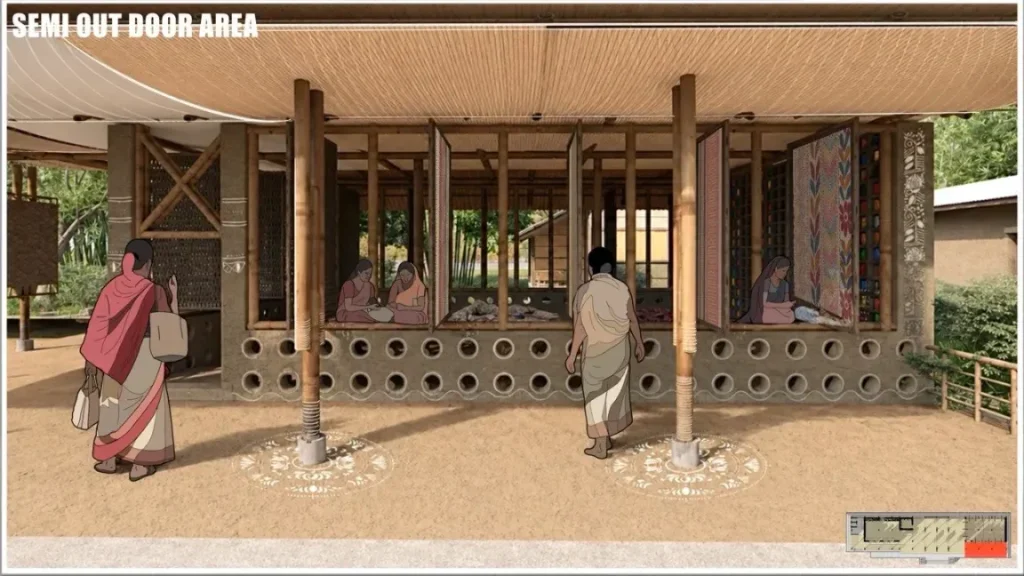
This project acknowledges a basic truth: if the makers leave, the tradition cannot continue. Thus the intervention starts at a micro level within the courtyard, the most intimate and culturally rooted spatial unit of rural Bengal. Rather than a single, centralised solution, the proposal envisions a decentralised network of adaptive courtyard workspaces embedded within individual households.
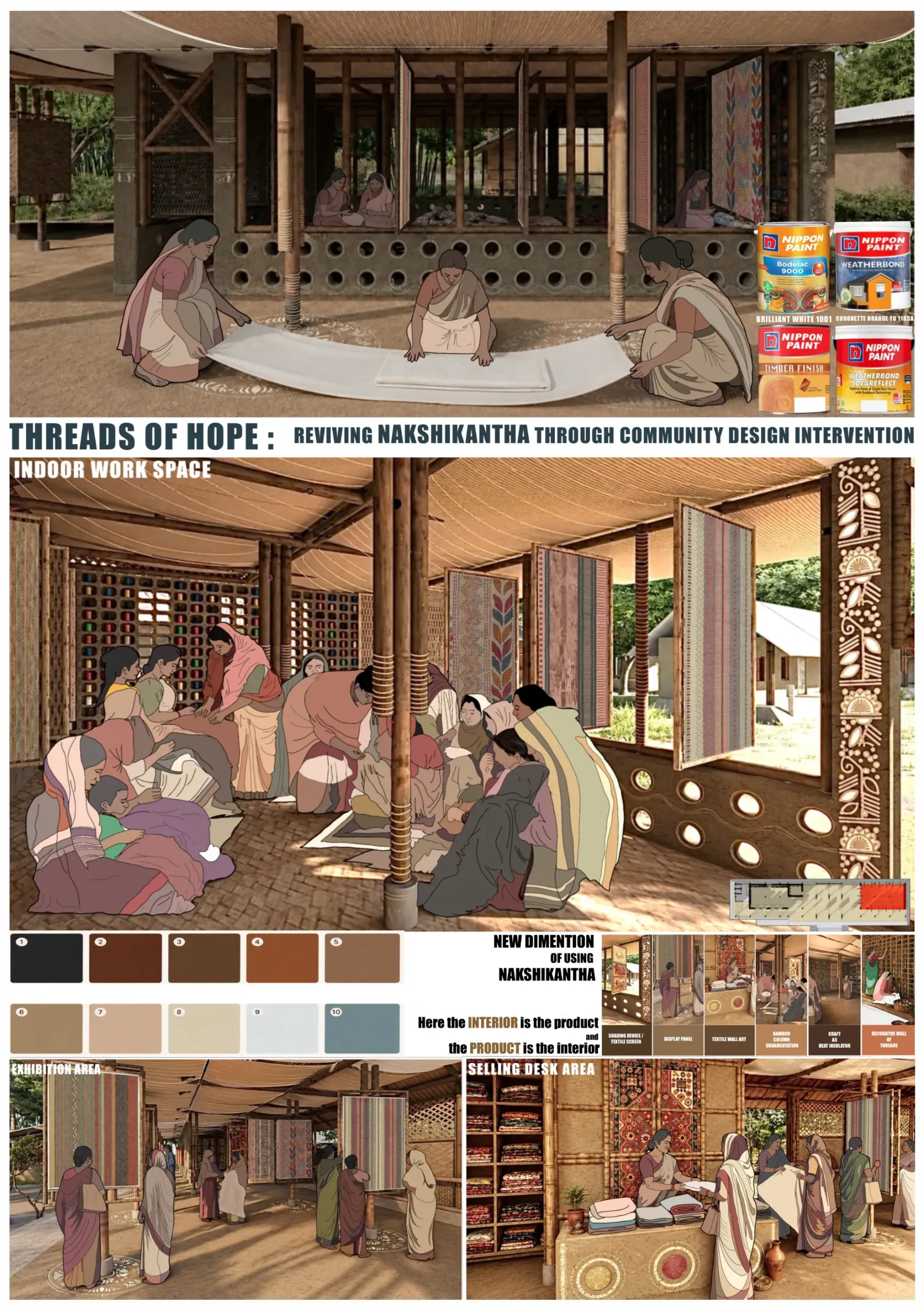
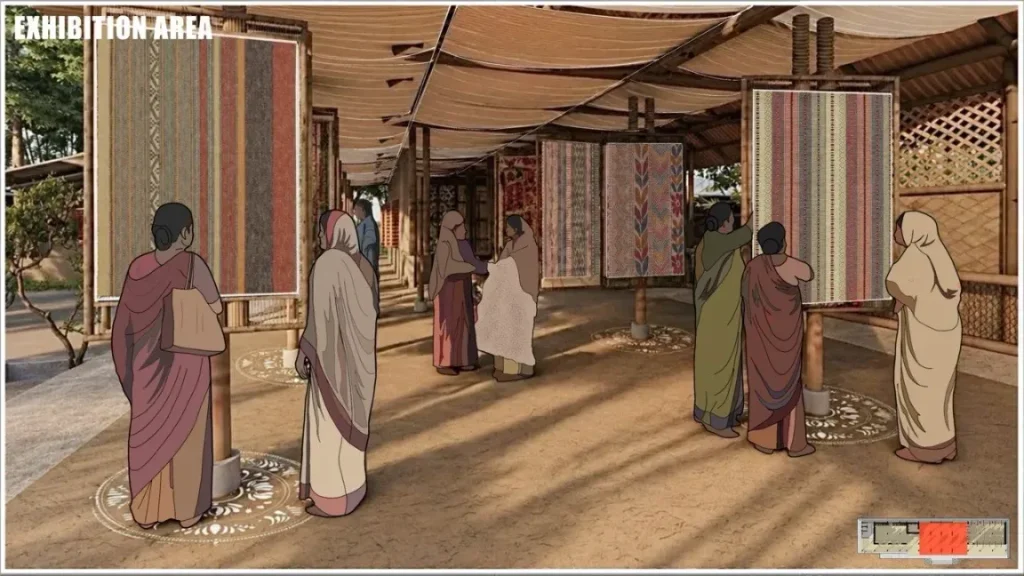
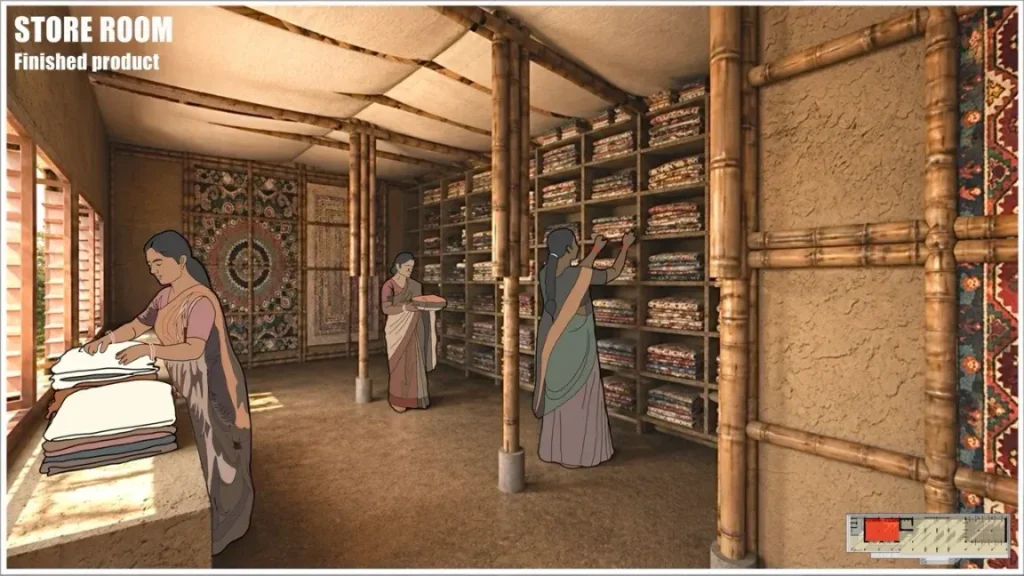
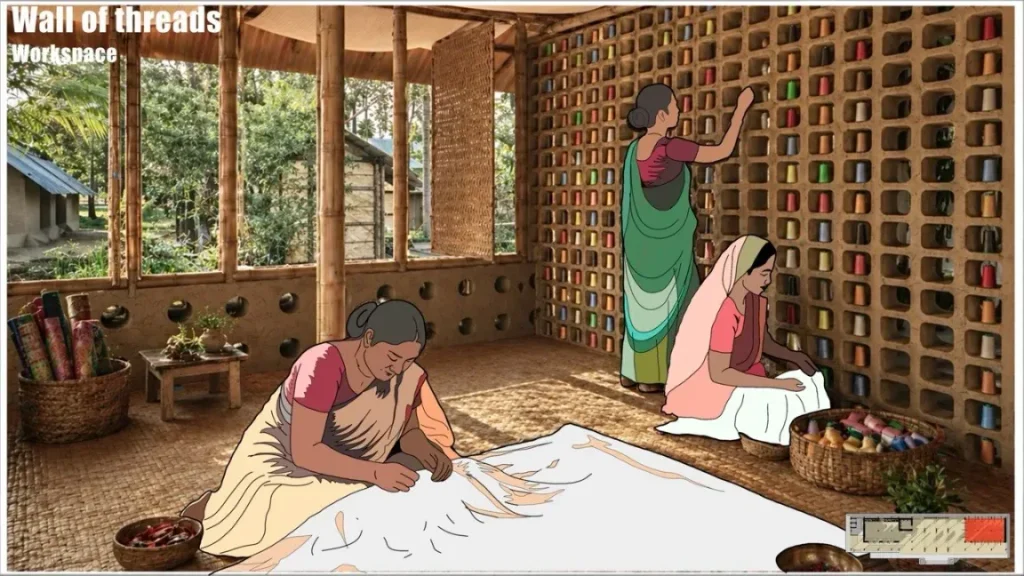
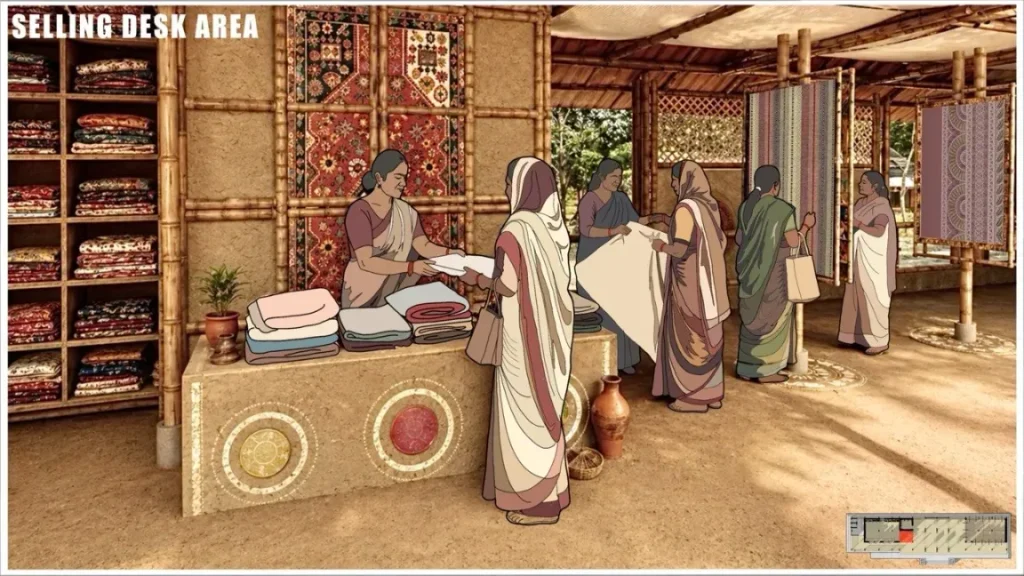
These reimagined courtyards become multifunctional production spaces of stitching, gathering, storing, packaging and selling. Grounded in local materiality and vernacular logic, they do not need specialised knowledge of construction so that artisans can define their own environments with familiar techniques. Nakshikatha is an integral part of the interior space, the line between product and space, function and identity is blurred.
This project bypasses exploitative middlemen, allowing artisans to connect directly with customers, ensuring fair compensation and economic upliftment. This not only brings the products to an affordable range for consumers but also restores dignity and value to the labour of the artisans. As incomes become more stable, families can invest in education, healthcare and overall well-being, building long-term social resilience.
On a larger scale, these interventions create a lively network across the village, a distributed community hub, in addition to the individual courtyards. Every courtyard is a site of activity and together they form a larger ecosystem of cultural and economic exchange. This decentralised approach offers the flexibility, scalability and adaptability to context, rather than the rigidity of one community centre.As the nodes proliferate, the village morphs into a vibrant production landscape – an organic economic zone powered by local skill and local resource. The continuity of practice ensures that the knowledge of Nakshikatha is passed on to future generations, not as a fading tradition but as a living, evolving livelihood.“Threads of Hope” is not just an architectural proposal but a fabric for cultural resilience.
Showcase your design to an international audience
SUBMIT NOW
Image: Agrapolis Urban Permaculture Farm by David Johanes Palar
Top
THREADS OF HOPE: REVIVING NAKSHIKANTHA THROUGH COMMUNITY DESIGN INTERVENTION. In the villages of Jamalpur, Bangladesh, Nakshikatha is more than a craft; it is a living archive of memory, emotion and identity. Every stitch tells a story, a story passed down from generation to generation, stitched by the hands of women who turn scraps of cloth into stories of life. Once a rural craft, deeply embedded in the everyday culture, Nakshikatha has now become a global symbol of Bangladesh across fashion and artisanal industries. But ironically, the communities that continue this tradition are slowly fading from it. This laborious craft has been losing its grip on people gradually due to rapid urbanisation, growing preference for nuclear family structures and the growing inclination towards easily available industrial alternatives. More importantly, the artisans themselves, many of whom hail from economically precarious situations, are being cut off from the spatial and social contexts that have supported their work. Due to population density and the fragmentation of living conditions, traditional shared courtyards where women used to get together, sew, talk and produce together are disappearing. As a result, the communal character of Nakshikatha is disintegrating.Artisans are forced to work in lonely improvised settings, which are not responsive to the climate nor socially engaging, because of lack of enough workspaces. Heat, rain and storms are other seasonal challenges that interrupt their productivity. Furthermore, exploitative market systems frequently deny them just wages, with intermediaries taking advantage of their craft and providing them with little pay. This economic imbalance, coupled with the failure to provide basic requirements like education and household stability, is forcing many artisans to give up their main profession. Some see it merely as a side hustle, some quit it altogether. This project acknowledges a basic truth: if the makers leave, the tradition cannot continue. Thus the intervention starts at a micro level within the courtyard, the most intimate and culturally rooted spatial unit of rural Bengal. Rather than a single, centralised solution, the proposal envisions a decentralised network of adaptive courtyard workspaces embedded within individual households. These reimagined courtyards become multifunctional production spaces of stitching, gathering, storing, packaging and selling. Grounded in local materiality and vernacular logic, they do not need specialised knowledge of construction so that artisans can define their own environments with familiar techniques. Nakshikatha is an integral part of the interior space, the line between product and space, function and identity is blurred. This project bypasses exploitative middlemen, allowing artisans to connect directly with customers, ensuring fair compensation and economic upliftment. This not only brings the products to an affordable range for consumers but also restores dignity and value to the labour of the artisans. As incomes become more stable, families can invest in education, healthcare and overall well-being, building long-term social resilience. On a larger scale, these interventions create a lively network across the village, a distributed community hub, in addition to the individual courtyards. Every courtyard is a site of activity and together they form a larger ecosystem of cultural and economic exchange. This decentralised approach offers the flexibility, scalability and adaptability to context, rather than the rigidity of one community centre.As the nodes proliferate, the village morphs into a vibrant production landscape – an organic economic zone powered by local skill and local resource. The continuity of practice ensures that the knowledge of Nakshikatha is passed on to future generations, not as a fading tradition but as a living, evolving livelihood.“Threads of Hope” is not just an architectural proposal but a fabric for cultural resilience.

The AYDA Awards is part of Colouring Lives, Nippon Paint’s Corporate Social Responsibility (CSR) programme, which is dedicated to nurturing the next generation of Architectural and Interior Design talents. Through cross-learning and industry exposure, AYDA provides a platform for students to develop their skills and grow as designers. Discover more of Nippon Paint’s CSR initiatives under Colouring Lives.